

The Wildlife and Environmental Crimes Prosecutions Database (WECPD)
Full Solution
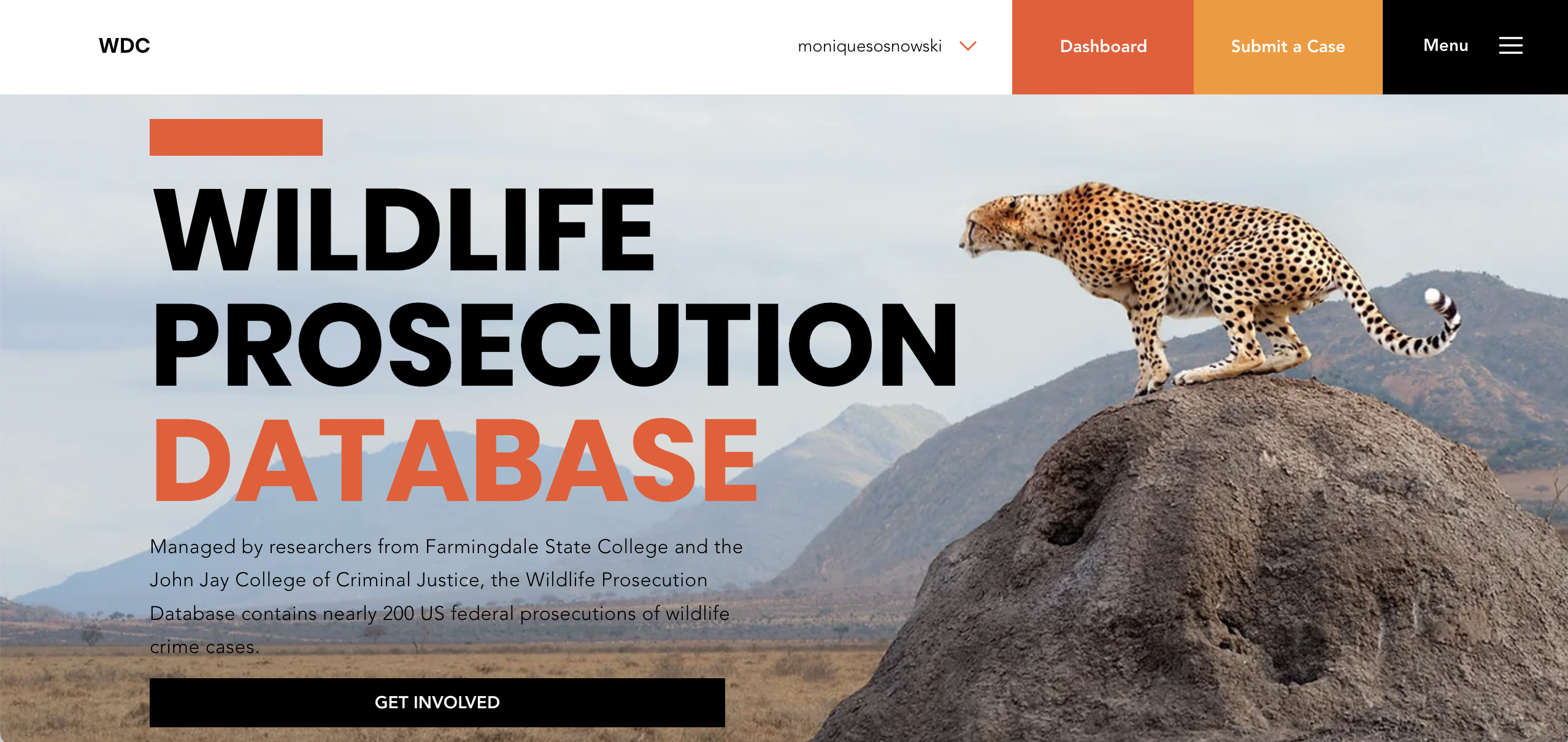
WECPD Website Landing Page
Monique Sosnowski
The Wildlife and Environmental Crimes Prosecutions Database is a pioneering initiative addressing the lack of centralized, accessible data on wildlife and environmental crime prosecutions. Using open-source tools and an interactive platform, the WECPD supports prosecutorial transparency, a basis for policy evaluation, strengthens enforcement, and promotes public and academic engagement with relevant crime prevention. The WECPD actively contributes to GBF Targets 4, 5, 20, 21, and 22 by helping halt species loss, tackle wildlife trade, and increase access to biodiversity-related data and justice. It also supports SDGs 14, 15, and 16.
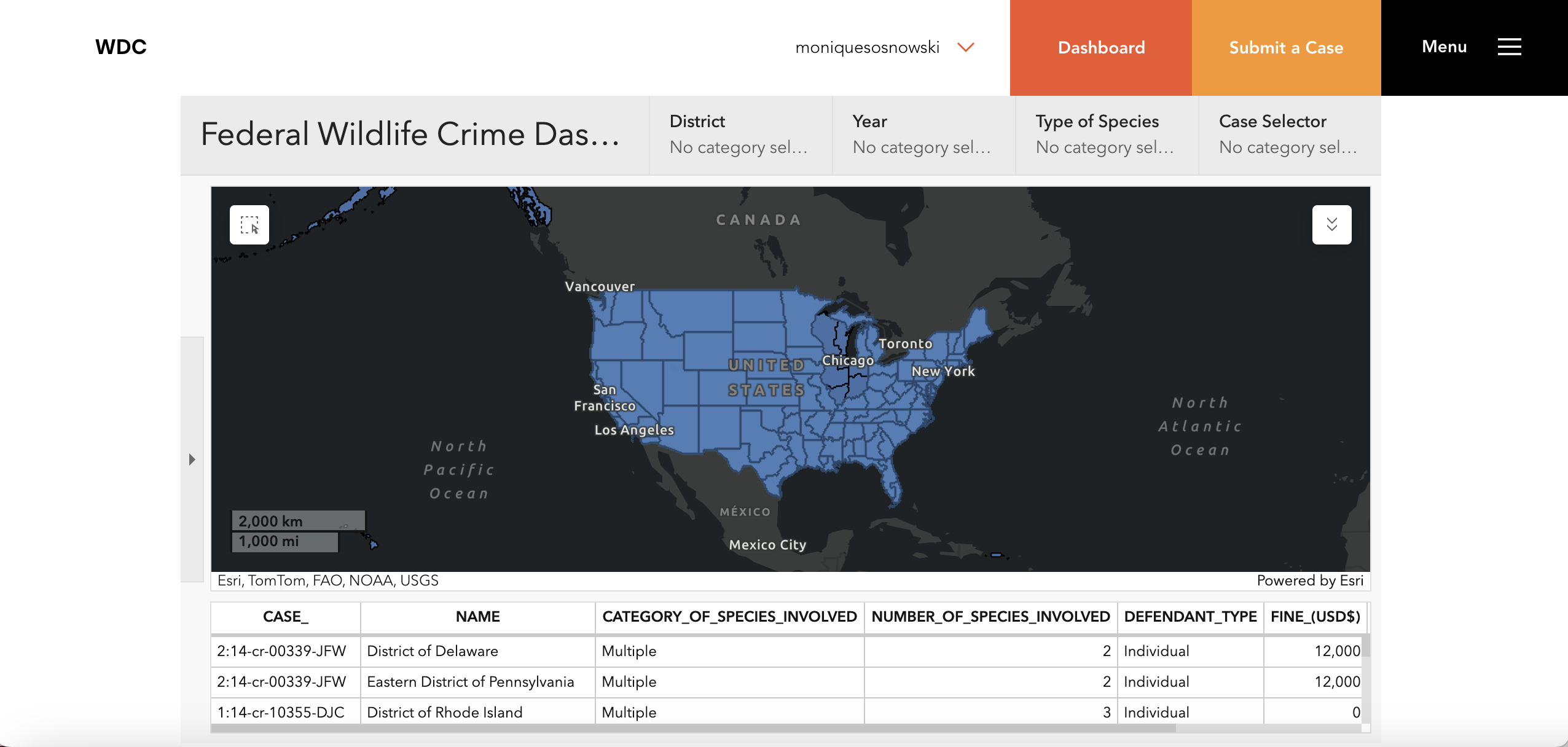
Beyond data aggregation, the platform offers user-friendly tools to visualize, filter, and download prosecution data. It fills key gaps in understanding how laws like US Executive Orders 13648 and 13773 and the END Wildlife Trafficking Act are enforced. This enables measurable, data-driven conservation responses. Designed for long-term sustainability, it uses scalable, global technologies.
Last update: 31 Oct 2025
280 Views
Photo and video gallery
Context
Challenges addressed
- Poaching, Unsustainable Harvest, and Invasive Species: The database is designed to track the prosecution of cases related to poaching, illegal harvesting, and the spread of invasive species in the United States. By documenting these federally prosecuted crimes, it provides insights into how laws like the Endangered Species Act, Lacey Act, and others are being enforced.
- Infrastructure Development: This project represents the creation of a groundbreaking digital infrastructure to track federal prosecutions of wildlife and environmental crimes in the United States for the first time. Currently, no centralized system exists to aggregate and analyze this critical data.
- Poor Monitoring and Enforcement: The database enables analysis of enforcement practices across different regions and agencies, exposing disparities and inconsistencies. This fosters accountability and supports the development of more equitable and effective enforcement strategies.
Location
United States
North America
Process
Summary of the process
The key success factors of the WECPD are intrinsically interconnected, with each component complementing and reinforcing the others to achieve impactful outcomes. The data aggregation tool forms the foundation, enabling the comprehensive collection and organization of federal prosecution data. This feeds directly into the interactive visualization platform, which transforms raw data into actionable insights, allowing stakeholders to identify trends and enforcement gaps effectively.
The case monitoring system builds on these insights, providing the granularity needed for detailed analysis of sentencing patterns and law enforcement practices. This, in turn, supports the policy evaluation framework, ensuring that the effectiveness of legal and enforcement measures, such as the Endangered Species Act, is continuously assessed and improved.
Lastly, stakeholder collaboration is facilitated through the platform's accessibility, enabling seamless interaction among policymakers, law enforcement, NGOs, and researchers. Stakeholders can learn from one another, engage in future learning tools, understand policy success, and guide their own resource allocations.
Building Blocks
Open-Source Data Aggregation Tool
The database uses open-source technologies to aggregate and structure federal prosecution data. This approach is scalable and adaptable, making it an effective tool for organizing and analyzing enforcement data in other domains, such as human trafficking, organized crime, or other environmental offenses.
Interactive Visualization Platform
The database integrates web design technologies and Esri ArcGIS to create a user-friendly interface for visualizing patterns and trends. This visual component can be adapted to various sectors to improve stakeholder engagement and decision-making, such as by local, state and federal wildlife and environmental agencies.
Federal Case Monitoring System
By collecting detailed data on federal prosecutions, this tool provides insights into enforcement patterns, sentencing trends, and legal applications. Similar systems could be developed to monitor prosecutions in areas like corporate fraud, tax evasion, or cybercrime.
Policy Evaluation Framework
The platform is designed to assess the effectiveness of laws and enforcement efforts, such as the Endangered Species Act and Lacey Act. This framework can be applied to evaluate policy impacts in other regulatory areas, like labor laws or international trade compliance.
Stakeholder Collaboration Portal
The database fosters collaboration by providing accessible tools for policymakers, law enforcement, researchers, and NGOs. This collaborative model could be replicated to facilitate cross-sector cooperation in combating global challenges such as climate change or poverty.
Impacts
The WECPD has shown significant environmental, social, and economic impacts. By analyzing over 558 federal cases involving 500+ species (2009–2021) (thus far, with little to no funding), it enhances biodiversity protection by identifying poaching, illegal fishing, and habitat destruction trends. Using Esri ArcGIS, it maps wildlife trafficking hotspots, supporting targeted conservation efforts and improved enforcement of laws like the Endangered Species Act.
Socially, the database empowers stakeholders—policymakers, law enforcement, researchers, and NGOs—with centralized, accessible information, fostering collaboration and accountability. For local communities, improved enforcement protects biodiversity crucial for cultural, ecological, and economic services, including agriculture and fisheries affected by invasive species.
Economically, the platform aids in disrupting organized crime by identifying links between wildlife crimes and larger criminal networks, reducing financial losses to legal markets. It also optimizes resource allocation by highlighting enforcement gaps, ensuring cost-effective strategies.
Quantifiable outcomes include case analyses revealing sentencing trends, improved enforcement success rates, and mapped hotspots enabling focused interventions. The database bridges critical data gaps, driving conservation, supporting communities, and fostering economic stability while combating crime.
Beneficiaries
The WECPD benefits government agencies, local communities, conservation groups, researchers, and ecosystems by increasing transparency, enabling accountability, supporting policy evaluation, and improving enforcement of laws protecting biodiversity.
Additionally, explain the scalability potential of your Solution. Can it be replicated or expanded to other regions or ecosystem?
The WECPD has significant scalability potential. Once the database is fully operational, the framework can be easily expanded to include state-level or international data, allowing for a comprehensive analysis of wildlife and environmental crimes. The technology and methodology can also be adapted to other regions or ecosystems globally, focusing on local legal frameworks and enforcement patterns.
The integration of tools like Esri ArcGIS makes the platform highly adaptable, capable of incorporating additional data layers such as international trafficking routes or regional conservation metrics. This scalability not only enhances enforcement and policy evaluation but also fosters global collaboration in combating wildlife and environmental crimes. By scaling to state data and beyond, the database aims to create a unified and transparent system for monitoring and addressing ecological challenges.
While the WECPD builds upon existing technologies such as web design tools and Esri ArcGIS for geospatial analysis, its innovation lies in the centralization, visualization, and policy relevance of federal wildlife and environmental crime data—something that has never before existed in a unified, accessible form. By aggregating and standardizing prosecution data from disparate sources, the database provides a transparent, interactive platform that enables stakeholders to identify enforcement trends, evaluate the effectiveness of laws, and promote accountability.
Importantly, the WECPD model-based analysis has already been successfully reproduced for Kenya, where it was adapted to track environmental crime prosecutions under that country’s legal framework. This demonstrates the solution’s real-world scalability and adaptability across jurisdictions. A peer-reviewed article detailing this replication effort is currently under review, further supporting the model’s academic rigor and global applicability.
To ensure sustainability and long-term access, the core platform is designed using open-source technologies to minimize dependency on costly infrastructure. While Esri ArcGIS provides advanced mapping capabilities, the visual and spatial components can be adapted to lower-cost or open-source alternatives (such as QGIS) to ensure scalability in low-resource settings. The modular design of the database allows for easy replication and customization, making it adaptable, affordable, and accessible to a global community of users working to advance environmental justice and informed enforcement.
To support replication and adaptation, the WECPD project includes clearly defined, replicable processes and tools. The database is built through a structured workflow involving students and professionals who retrieve case data directly from the U.S. Department of Justice (DOJ) (or other relevant agencies), code the information using a standardized codebook, and input the data into Excel or Google spreadsheets. These coded datasets are then uploaded to the WECPD platform, which integrates web design technologies and Esri ArcGIS to generate searchable, visual, and downloadable outputs.
The codebook—used in both academic and practical settings—includes variables such as species type, prosecution district, statute violated, sentencing outcome, and length of case, among others. This structured format ensures consistency, comparability, and transparency across entries, making the database both academically robust and adaptable for other contexts.
Replication Guidance and External Resources
To facilitate replication:
- The full codebook used for data input is available for download and adaptation.
- A user guide and training module are currently in development, which will outline best practices for data extraction from PACER/DOJ bulletins (currently in use), data coding, and platform upload procedures.
- The database is being built in modular form, so institutions or researchers can replicate portions (e.g., by region, statute, or species group) using free tools like Excel, QGIS, or open-source visualization platforms if ArcGIS is cost-prohibitive.
Sustainability and Scalability Considerations
While the current platform utilizes Esri ArcGIS for its advanced mapping and geospatial functionality, we recognize the need for long-term sustainability and accessibility in low-resource contexts. For this reason, the WECPD architecture is designed to be interoperable with open-source alternatives, such as QGIS, allowing the core functions of the database to be preserved and adapted without licensing constraints. Data entry remains Excel-compatible to reduce software barriers, and future developments will include plug-and-play templates for new jurisdictions or sectors (e.g., state-level expansion, forestry crimes, marine protected areas).
By openly sharing the methodology, variables, and workflow documentation, WECPD ensures that the model can be replicated, adapted, and scaled by governments, NGOs, academic institutions, and community organizations across different legal and ecological contexts.
Global Biodiversity Framework (GBF)
GBF Target 4 – Halt Species Extinction, Protect Genetic Diversity, and Manage Human-Wildlife Conflicts
GBF Target 5 – Ensure Sustainable, Safe and Legal Harvesting and Trade of Wild Species
GBF Target 20 – Strengthen Capacity-Building, Technology Transfer, and Scientific and Technical Cooperation for Biodiversity
GBF Target 21 – Ensure That Knowledge Is Available and Accessible To Guide Biodiversity Action
GBF Target 22 – Ensure Participation in Decision-Making and Access to Justice and Information Related to Biodiversity for all
Sustainable Development Goals
SDG 14 – Life below water
SDG 15 – Life on land
SDG 16 – Peace, justice and strong institutions
Story

Monique on a hike at Franconia Notch with her dog Jackson
Patrick Ruddick
The WECPD was born out of a realization that stemmed from years of research. Dr. Gohar Petrossian and I had been studying hundreds of thousands of wildlife seizures for various research projects, analyzing the scale and scope of illegal wildlife trafficking. Our work uncovered intricate networks and patterns in the illegal trade of species and wildlife products, but one glaring question persisted: What happens after the items were seized?
Despite the immense number of seizures documented, there seemed to be shockingly few federal court cases focused on wildlife and environmental violations. This led us to a troubling conclusion—there was no systematic way to track what happens after enforcement agencies seize wildlife products. Were these cases being prosecuted? If so, what were the outcomes? How were the Endangered Species Act, Lacey Act, and other critical laws being applied to combat these crimes?
This gap was especially concerning in the context of the evolving policy landscape. Executive Orders 13648 and 13773, along with legislative efforts such as the END Wildlife Trafficking Act, were introduced to strengthen the fight against wildlife crime. These measures emphasized the importance of enforcement and accountability, yet we had no comprehensive data on how these laws were being implemented or whether they were achieving their intended goals.
This lack of information was not just a hurdle for our research but also a barrier to effective policymaking and enforcement. How could we evaluate the success of these interventions without understanding the trends and patterns in federal enforcement? How could we identify gaps in enforcement or opportunities for improvement without access to this data?
This pressing need for clarity and accountability inspired the creation of the WECPD. The idea was to develop a centralized, accessible platform that could aggregate and analyze data from federally prosecuted wildlife and environmental crimes. The goal was to provide a tool for researchers, policymakers, law enforcement, and the public to understand enforcement patterns, evaluate policy effectiveness, and promote transparency.
So far, we have not only been able to aggregate and analyze hundreds of cases, but we have published our initial results. Please see the article (open-access) here. This article has thus far been read and downloaded by nearly 10,000 people.