Cross-Sectoral Exchange For Improved Management Of Natural Resources In Rwanda
Full Solution
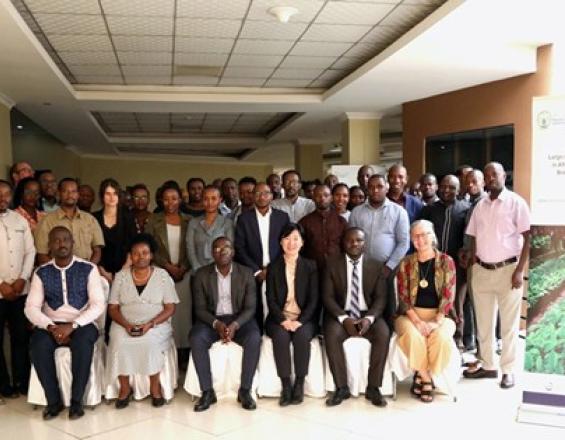
16th Cross-sectoral Taskforce Meeting on Forest Landscape Restoration and Sustainable Agriculture
IUCN
The Cross-Sector Taskforce (CSTF) was established in 2015 to coordinate Rwanda’s response to the Bonn Challenge and enhance Forest Landscape Restoration (FLR) efforts. Comprising 35 member organizations, including government bodies, NGOs, private sector actors, and research institutions, the CSTF fosters collaboration, shares technical knowledge, and harmonizes FLR monitoring systems. It provides a platform for addressing deforestation, land degradation, and biodiversity loss while aligning restoration efforts with national and international strategies like the Green Growth and Climate Resilience Strategy (GGCRS), AFR100, and the Paris Agreement. Recent meetings have focused on integrating FLR with sustainable food systems, improving monitoring tools, and incentivizing local farmers. By facilitating knowledge exchange and improving governance, the CSTF enhances restoration efforts and strengthens Rwanda’s ability to meet its target of restoring 2 million hectares of land by 2030.
Last update: 02 Dec 2025
86 Views
Photo and video gallery


Context
Challenges addressed
The CSTF addresses several critical challenges in coordinating FLR efforts in Rwanda. Environmentally, deforestation, land degradation, and biodiversity loss remain major concerns, exacerbated by shifting cultivation and urbanization. Also, there is a lack of common understanding and information among stakeholders on what constitutes FLR and what initiatives are up and running, hindering unified action and coordination. Monitoring restoration progress is complicated by inconsistent definitions of indicators and the slow pace at which restoration produces measurable biological, social, and economic outcomes.
Location
Kigali, Rwanda
West and Central Africa
East and South Africa
Process
Summary of the process
The building blocks of the CSTF form an integrated system for coordinating FLR efforts in Rwanda. The taskforce’s establishment provides a formal platform for multi-stakeholder collaboration, while its governance and leadership ensure clear accountability and shared ownership. The operational framework facilitates regular meetings, enabling members to align action plans and monitor progress effectively. Knowledge exchange further supports the taskforce by equipping stakeholders with tools, data, and best practices to improve FLR implementation. Together, these components create a streamlined approach to addressing deforestation, land degradation, and biodiversity loss, while supporting national and international restoration goals.
Building Blocks
Establishing an inclusive and multi-sectoral taskforce
The CSTF was established in 2015 as a national-level platform to coordinate Rwanda’s response to the Bonn Challenge and improve Forest Landscape Restoration (FLR) efforts. It comprised members from 13 government bodies, 8 civil society organizations, 7 development partners, and 7 private sector and research organizations. The taskforce provides a space for collaboration, knowledge sharing, and strategic planning to address key issues such as land degradation, deforestation, erosion, and biodiversity loss.
Enabling factors
- Strong governmental support from the Ministry of Environment and Ministry of Agriculture.
- Broad representation of stakeholders across multiple sectors ensures diverse perspectives.
- Support from development partners, who have acted as secreteriat to support the political partners, such as IUCN, WRI, FAO and GIZ
Lesson learned
The formation of a dedicated, multi-stakeholder taskforce ensures that FLR efforts are inclusive, coordinated, and aligned with national and international restoration goals.
Rotating leadership and joint governance
The CSTF operates under a governance structure that ensures leadership rotation and collaboration across sectors. Meetings are chaired alternately by the Ministry of Environment and the Ministry of Agriculture, with support from development partners for logistical and organizational tasks. This leadership structure strengthens the coordination of FLR and Sustainable Food and Agriculture (SFA) initiatives and ensures that restoration initiatives align with broader national development strategies, such as the National Strategy for Transformation (NST1) and Vision 2050, while meeting international targets like the AFR100 and Global Biodiversity Framework (GBF).
Enabling factors
- Rotating chairmanship between the two key ministries enhances shared leadership.
- Development partners, such as IUCN, provide organizational support.
- Annual and bi-annual meetings enable consistent progress evaluation.
Lesson learned
A rotating leadership model promotes shared ownership and enhances the taskforce’s ability to align its efforts with evolving national and international priorities.
Continuity and Operational Framework of the CSTF
The CSTF facilitates regular meetings to discuss FLR and SFA strategies, action plans, and project monitoring. The CSTF performs a range of tasks to coordinate FLR and Sustainable Food and Agriculture (SFA) efforts across Rwanda. It provides strategic policy and management guidance, makes decisions to align initiatives with national policies, and resolves operational challenges. The taskforce reviews action plans, budgets, and major reports, such as annual results and mid-term reviews, to ensure sustainability and quality control. It also identifies funding opportunities to support scaling FLR and SFA initiatives, enhances coordination among stakeholders, and facilitates discussions on new project plans. In addition, the CSTF ensures effective knowledge sharing, develops strategies for improving environmental, social, and economic sustainability, and reviews stakeholder engagement to maximize the involvement of private sector actors and other partners. The taskforce also coordinates efforts to address strategic changes and ensures that restoration activities meet national and international goals.
Enabling factors
- Regular meetings allow stakeholders to review and align their plans.
- Mechanisms for sharing project reports, mid-term reviews, and evaluations.
- Strategic decision-making on policy and governance structures.
Lesson learned
An effective operational framework allows for better alignment of stakeholder activities and helps address challenges in a timely manner.
Impacts
Discussions within the CSTF have led to practical advancements, such as incorporating tree planting into road construction budgets and developing a community centric FLR engagement guide. Technically, the taskforce has streamlined FLR monitoring by harmonizing indicators and promoting the adoption of the Forest Management Information System (FMIS). This has improved data collection and reduced duplication of research efforts among stakeholders. Economically, the taskforce has advocated for diverse funding mechanisms, including private sector investments and concession agreements, to support FLR initiatives. The CSTF’s coordination has also helped prevent redundant efforts, exemplified by research on tree species adoption shared by ICRAF, which avoided duplication by the Rwanda Agriculture Board. Overall, the taskforce has strengthened FLR planning, monitoring, and implementation in Rwanda.
Beneficiaries
The CSTF benefits government agencies, NGOs, the private sector, and local communities by improving FLR coordination, monitoring, and funding mechanisms. Its work supports improved resource management, benefiting ecosystems, farmers, and the broader economy.
Global Biodiversity Framework (GBF)
GBF Target 2 – Restore 30% of all Degraded Ecosystems
GBF Target 10 – Enhance Biodiversity and Sustainability in Agriculture, Aquaculture, Fisheries, and Forestry
Sustainable Development Goals
SDG 13 – Climate action
SDG 15 – Life on land
SDG 17 – Partnerships for the goals
Story
At the 16th Cross‑Sectoral Taskforce Meeting (CSTF) on Forest Landscape Restoration and Sustainable Agriculture in Rwanda, a diverse group of government, NGO and community-level stakeholders convened by Ministry of Environment, Rwanda and IUCN came together to deliberate on strengthening coordination across sectors. Listening to the discussion, from forestry to agriculture, land use, and rural livelihoods, underscored how critical it is for institutions to harmonise their policies and translate them into coherent, landscape-level actions. The emphasis on local technical capacity and extension services was particularly striking: without clear institutional understanding and cross-sector coordination, even well-intentioned restoration and sustainable agriculture commitments risk being on paper.
Reflecting on the exchange, it was convincing that the way forward lies in strengthening institutional alignment: national ministries, land and forestry authorities, agriculture, environment, and community partners must jointly adopt tools like landscape restoration planning, monitoring systems, and integrated extension services. This coherence will enable Rwanda to turn restoration policy into effective, ground-level Forest Landscape Restoration (FLR) implementation, delivering both ecological and livelihood benefits sustainably.